

Last updated November 5, 2026. Reviewed by the HomePilot editorial team.
Checklist · Water heaters
Few things wreck a winter morning faster than stepping into a shower that never warms up. When the hot water disappears, the cause is usually one of a handful of simple problems: a tripped breaker or reset button on an electric water heater, or a pilot light that went out on a gas one. This checklist walks you through the checks in order, starting with the ones that take a minute and cost nothing, so you know whether you can fix it yourself or need a plumber.
By the HomePilot Team · Updated November 5, 2026 · Based on manufacturer and plumbing troubleshooting guidance · How we research
Before you start
- Smell gas? Do not try to light anything or flip switches. Leave the home and call your gas utility from outside.
- Electric water heater: turn the breaker off before removing any access panel; the wiring behind it carries 240 volts.
- The water in the tank can scald. Be careful near valves and drain fittings.
- Know your type: a gas water heater has a vent pipe on top and a gas line; an electric one has a thick electrical cable and no vent.
Short answer: on an electric water heater, check the breaker, then press the red reset button behind the upper access panel. On a gas water heater, check that the gas is on and the pilot light is lit; relight it following the label. If the pilot will not stay lit, or the reset button keeps tripping, call a professional.
The no-hot-water checklist
First 5 minutes: any water heater
- Is it every faucet or just one? If only one tap is cold, the problem is that faucet or shower valve, not the water heater.
- Did you just use a lot of hot water? Back-to-back showers, laundry and the dishwasher can empty the tank. Wait 30 to 60 minutes and test again.
- Check the temperature setting. About 120°F suits most homes; a dial bumped too low gives lukewarm water.
- Look for water around the base. A leaking tank usually means replacement; turn off the cold-water supply valve above the tank.
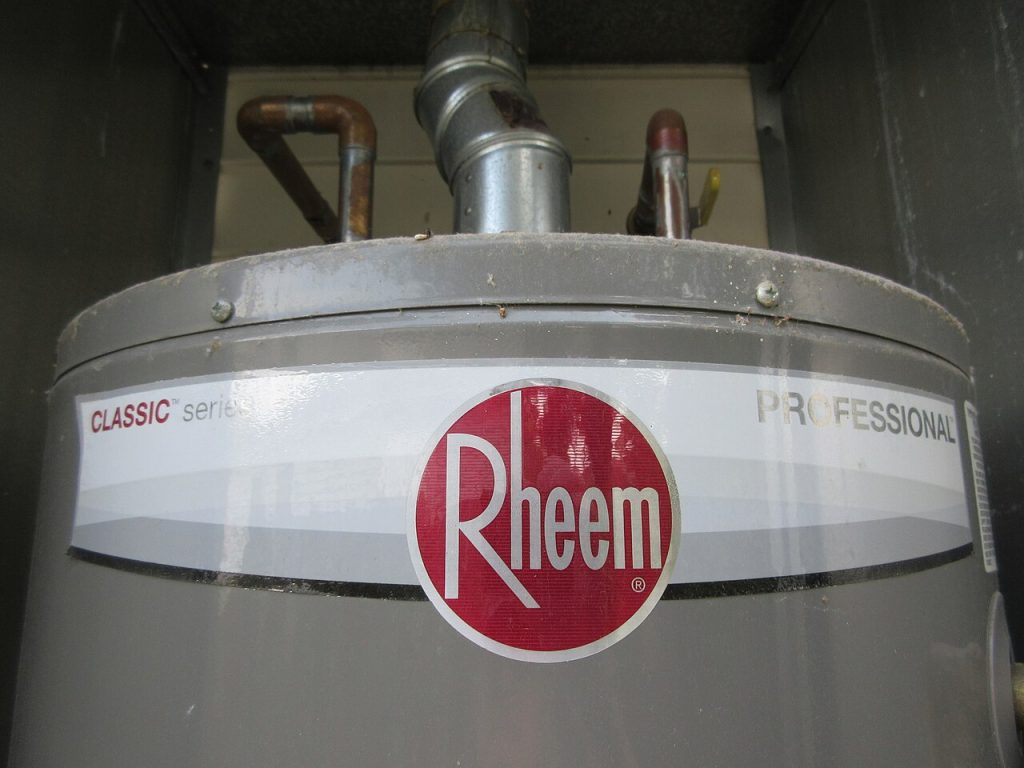
- Note the age. The model sticker often shows the manufacture date. Tank water heaters typically last about 10 years.
Electric water heater
- Check the breaker. Water heaters usually have a double breaker in the panel. A tripped one may sit in the middle position; switch it fully off, then on.
- If the breaker trips again right away, stop. That points to a short in an element or the wiring; call an electrician or plumber.
- Press the reset button. With the breaker off, remove the upper access panel and insulation, and press the red high-limit reset button. You may hear a click. Replace the panel, turn the breaker on and wait about 30 minutes.
- If the reset button keeps tripping, a thermostat or heating element is likely failing; call a pro.
- No hot water at all often means the upper element or thermostat has failed; hot water that runs out fast often means the lower element has failed.
Gas water heater
- Confirm the gas is on. Check that the gas valve to the heater is open and that other gas appliances, like the stove, work.
- Look for the pilot light through the small viewing window near the bottom of the tank.
- Relight the pilot exactly as the instructions on the heater’s label describe; usually you turn the knob to Pilot, hold it down and press the igniter.
- If the pilot will not stay lit after you release the knob, the thermocouple, a safety sensor that shuts off the gas when it does not detect the pilot flame, is likely faulty. That is a job for a technician.
- Check for drafts. A strong draft or a gusty day can blow out the pilot; make sure the burner access cover is in place.
- Newer models may lock out after a fault and show a blinking code; check the manual for what it means.
Tankless water heater
- Read the error code on the display and look it up in the manual.
- Check gas and power; tankless gas units still need electricity.
- Clean the inlet filter if water flow is weak.
- Descale it if you have hard water and it has not been flushed in a year or more.
Why hot water problems spike in winter
Water coming into your home is much colder in winter, so a water heater has to work harder to bring it up to temperature. A tank that kept up fine in summer may run out sooner, and a setting that felt hot in August can feel lukewarm in January. Cold snaps also bring frozen pipes: if one faucet suddenly has no water at all, hot or cold, suspect a frozen line rather than the water heater, and follow our frozen pipe guide to thaw it safely.
Lukewarm water vs no hot water
| Symptom | Likely cause |
|---|---|
| No hot water at all (electric) | Tripped breaker, tripped reset button or failed upper element |
| No hot water at all (gas) | Pilot out, gas off or failed thermocouple |
| Hot at first, then runs out fast | Failed lower element (electric), sediment buildup or tank too small for your household |
| Lukewarm water | Temperature set too low or a failing thermostat |
| Rumbling or popping, less hot water | Sediment buildup; see why water heaters pop |
Repair or replace?
- Repair if the heater is under about 10 years old and the problem is a part such as an element, thermostat or thermocouple.
- Replace if the tank itself leaks; tank leaks are rarely fixable.
- Lean toward replacing an older heater that needs a costly repair. See how long appliances last and the repair-or-replace rule.
- Choosing a new one? Compare tankless vs tank and what size you need.
Keep it from happening again
- Flush the tank yearly to clear sediment.
- Keep the area around a gas water heater clear and its burner cover in place.
- Keep the temperature around 120°F to save energy and reduce scald risk.
- Add a water leak sensor beside the tank for early warning.
Frequently asked questions
Why do I suddenly have no hot water?
On an electric water heater, the most common causes are a tripped breaker or a tripped high-limit reset button. On a gas water heater, the pilot light has usually gone out or the gas supply is off.
Where is the reset button on a water heater?
On most electric water heaters, it is a red button on the upper thermostat, behind the upper access panel and insulation. Always turn off the breaker before opening the panel.
Why won’t my water heater pilot light stay lit?
Usually a faulty thermocouple, the safety sensor that shuts off the gas when it does not detect the pilot flame. A technician can replace it.
Why does my hot water run out so fast?
On an electric heater, a failed lower element is a common cause. Sediment buildup, a low thermostat setting or a tank too small for your household can also cause it.
How long should I wait for hot water after resetting?
Give a tank water heater about 30 to 60 minutes to heat a meaningful amount of water after a reset or relight.

