
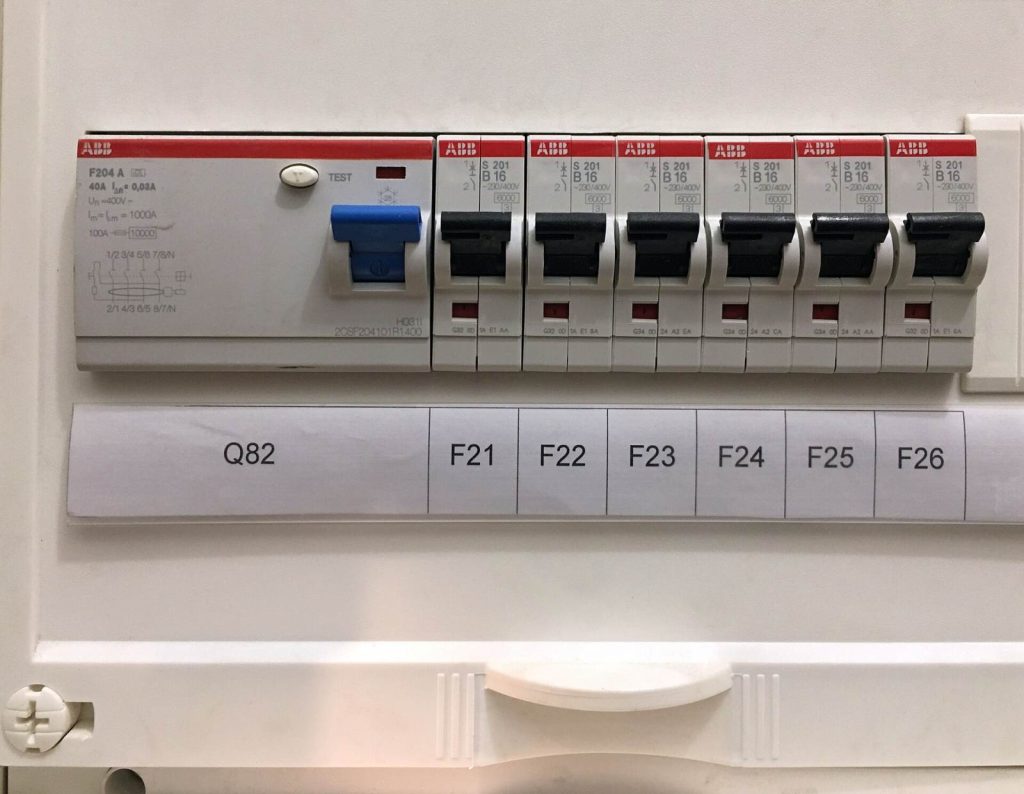
Space heater on, microwave on, and the lights go out. A tripped breaker is the circuit protecting itself from more current than its wires can safely carry. Before you plug in that heater, add up what shares the circuit. Tap in what runs at the same time, choose your breaker size, and this checker tells you whether it will trip and what to move.
How much can a 15-amp or 20-amp circuit handle?
On a standard 120-volt U.S. circuit, watts equal volts times amps. A 15-amp breaker trips above about 1,800 watts, and a 20-amp breaker above about 2,400 watts. For loads that run for hours, the safe limit is lower:
| Breaker | Trips above about | Safe for 3+ hours (80%) | Largest single plug-in appliance (80%) |
|---|---|---|---|
| 15 A | 1,800 W | 1,440 W | 12 A (1,440 W) |
| 20 A | 2,400 W | 1,920 W | 16 A (1,920 W) |
The 80% figures come from the National Electrical Code. As IAEI Magazine explains, a continuous load is one that runs for three hours or more, and circuits are sized so those loads stay within 80% of the breaker rating. The same article notes the code limits a single plug-in appliance to 80% of the circuit rating: 12 amps on a 15-amp circuit.
Why space heaters trip breakers so often
Heater maker Lasko notes that a 1,500-watt space heater on high draws 12.5 amps, and that bedrooms are typically on 15-amp circuits. That single heater already uses most of the circuit, and it runs for hours. Add a 1,100-watt microwave or a hair dryer and the total passes 1,800 watts. Lasko’s advice: run a space heater on a circuit with nothing else on it where you can, never on a power strip or extension cord, and don’t run high-current appliances such as a microwave and toaster oven together on one circuit.
Family Handyman gives a real example: a 10-amp microwave and a 14-amp air fryer on one 20-amp kitchen circuit add up to 24 amps, and the breaker tripped. It also points out that kitchens and bathrooms usually have 20-amp circuits, while living rooms and bedrooms are more likely to be 15-amp.
Frequently asked questions
How do I know which outlets share a breaker?
Plug a lamp or phone charger into each outlet, switch one breaker off, and note what goes dead. Outlets in neighboring rooms are often on the same circuit.
My breaker trips even with little plugged in. Why?
That points to something other than overload, such as a short circuit, a ground fault or a failing breaker. Our guide to why a circuit breaker keeps tripping walks through the causes, and a licensed electrician should check anything that sparks, smells hot or trips with nothing running.
Can I just replace a 15-amp breaker with a 20-amp one?
No. The breaker is sized to protect the wire in the wall. A bigger breaker on wire made for 15 amps lets the wire overheat. Adding a new circuit is a job for a licensed electrician.
Related: space heater safety, what a space heater costs per night, and every free tool on the Tools page.
Sources: Lasko, “Learn About Your Home’s Circuits to Run Space Heaters Safely”; IAEI Magazine, “Article 210 continued” (NEC continuous loads and cord-and-plug limits); Family Handyman, “How Circuit Breakers Work.” Appliance wattages are typical; check your appliance’s label. Last updated: November 2026.