

Last updated November 17, 2026. Reviewed by the HomePilot editorial team.
Fix It · Kitchen
You open the dishwasher expecting clean, dry dishes and find a murky puddle at the bottom instead. It is a common problem, and a gross one, but it is rarely serious. Repair guides agree that most dishwashers stop draining because of a simple clog, usually in the filter, the drain hose or the connection to the garbage disposal. The fix often costs nothing and takes less than an hour. Here is how to get the water out safely, work through the causes in the right order and know when to call a pro.
By the HomePilot Team · Updated November 17, 2026 · Based on guidance from appliance makers and repair services · How we research
Quick fix
Turn off the power to the dishwasher at the breaker, scoop out the standing water and remove and rinse the filter in the bottom of the tub. Then run the garbage disposal for about 15 seconds, since many dishwashers drain through it. If you recently had a disposal installed, the knockout plug inside its dishwasher inlet may never have been removed. Finally, check the drain hose under the sink for kinks and the air gap on the counter for debris.
What is blocking the drain?
| What you notice | Likely cause | Fix |
|---|---|---|
| Water pools after every cycle, food bits in the tub | Clogged filter | Remove and clean the filter |
| Started right after a new disposal was installed | Knockout plug still in the disposal inlet | Remove the plug |
| Sink drains slowly or the disposal is full | Clogged disposal or sink drain | Run and clear the disposal; clear the drain |
| Gurgling, or water splashes from the air gap | Clogged air gap | Clean the air gap |
| Dishwasher hums but water stays | Kinked or clogged drain hose, or a jammed pump | Check the hose; call a pro if it is the pump |
| No hum, no draining at all | Failed pump or a control problem | Call a technician |
First, get the water out safely
- Cut the power at the breaker. Do not work around standing water with the dishwasher still connected.
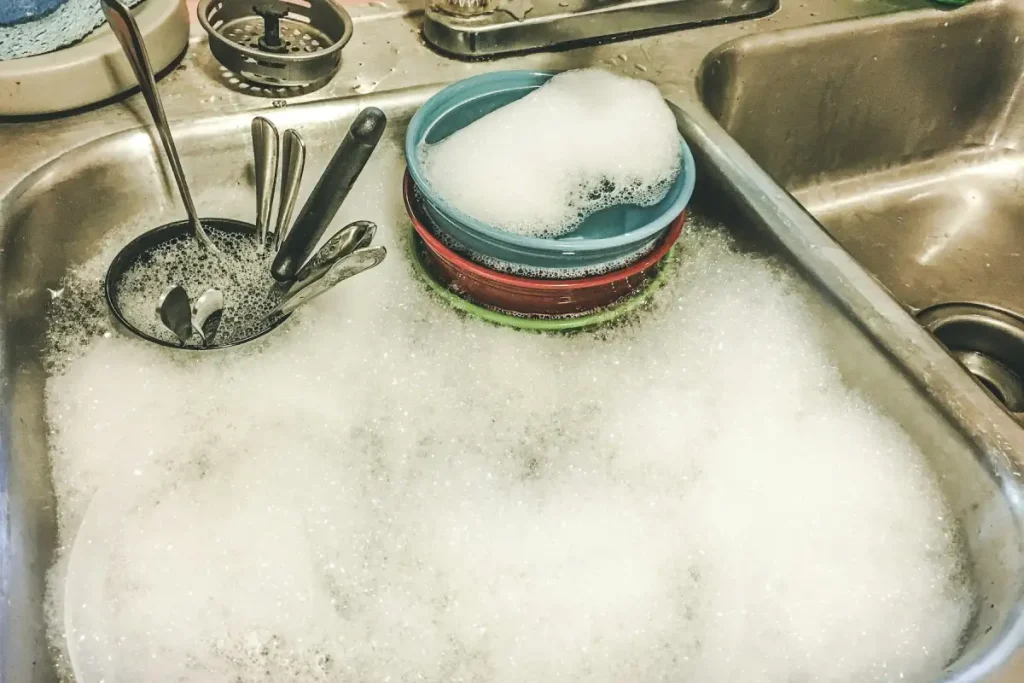
- Scoop out the water with a cup or small bowl and pour it into the sink.
- Soak up what is left with a towel or sponge.
- Remove any loose food and dishes from the bottom rack so you can reach the filter.
Step-by-step: fix a dishwasher that will not drain
- Check for a reset or a finished cycle. Some dishwashers pause before the drain step. Run a drain or cancel cycle if yours has one, or restart the cycle.
- Clean the filter. Twist out the filter at the bottom of the tub, wash it in warm, soapy water and rinse it well. Reinstall it flat and locked in place; a loose filter can cause leaks and poor cleaning.
- Look at the sump. With the filter out, check the area below it for broken glass, labels, seeds or toothpicks and remove anything you find.
- Run the garbage disposal. If your dishwasher drains into the disposal, run it with cold water for about 15 seconds to clear anything stuck at the inlet.
- Check the knockout plug. If a disposal was recently installed or replaced, make sure the plastic knockout plug in the dishwasher inlet was removed. If it is still there, the dishwasher physically cannot drain into the disposal.
- Inspect the drain hose. Under the sink, look for a hose that is kinked, crushed or pinched behind the cabinet. Straighten it. If it is clogged, disconnect it over a bucket and clear it out.
- Clean the air gap, if you have one. It is a small cylinder near the faucet. Pop off the cap, remove the diverter and clear out any gunk with a small brush.
- Run a test cycle with no dishes and see if the water drains.
Shop dishwasher cleaner tablets on Amazon → · Shop cleaning brush sets → (As an Amazon Associate, HomePilot earns from qualifying purchases.)
The causes, explained
A clogged filter
The filter keeps food particles out of the drain pump. Depending on your model it may be a manual filter you clean yourself or a self-cleaning one. When it fills with food, labels and grease, water cannot pass. It is the most common cause and the quickest fix.
The garbage disposal connection
In many homes the dishwasher drain hose connects to the garbage disposal. If the disposal is full or clogged, the dishwasher cannot empty. And if the disposal is new, the plastic knockout plug in its dishwasher inlet has to be knocked out when the dishwasher is connected. Sears Home Services says an unremoved plug is the single most common cause it sees on new-installation service calls. You may need to loosen the hose, reach into the inlet and punch out or remove the plug, with the disposal and dishwasher unplugged. See our guide to a garbage disposal that will not work.
The drain hose
The drain hose runs from the pump under the dishwasher up to the disposal or an air gap. A kink from a tight installation, or hardened grease inside, can block it. Many installations loop the hose high under the counter to keep sink water from flowing back, and an improper loop can cause problems.
A clogged air gap
Some homes have an air gap, a small cylinder on the sink or countertop that prevents dirty water from flowing back into the dishwasher. Some places require one by plumbing code. Food debris can clog it, and water gurgling or spilling from the air gap during draining is a clue.
A slow sink drain
If the kitchen sink or disposal drains slowly, the dishwasher has nowhere to send its water. Clear the sink drain first, and if that does not help, the clog may be farther down the line.
A failed drain pump
If the filter, disposal, hose and air gap all check out and water is still sitting in the tub, the drain pump may be jammed or failed. Testing it involves electrical work and often taking the dishwasher out, so this is a job for a technician. You may hear a humming sound with no water moving, or hear nothing at all during the drain step.
Call a technician if
- The filter, hose, disposal and air gap are all clear and the water still will not drain.
- The pump hums or makes a grinding noise.
- Water leaks from underneath the dishwasher.
- An error code on the display points to the pump or drain.
- The dishwasher trips the breaker, or you see wet wiring.
Is some water normal? A small amount of water around the filter area can be normal on some models, and some dishwashers hold a little in the sump between cycles. If water covers the bottom of the tub or is still there after the cycle ends, that is a drainage problem. Your owner’s manual will tell you what is normal for your machine.
Prevent it from happening again
- Scrape, do not rinse. Scrape large scraps into the trash before loading; our guide to dishwasher vs hand washing explains why pre-rinsing is unnecessary.
- Clean the filter every month or two, more often if you cook a lot.
- Run the garbage disposal before starting the dishwasher.
- Keep glass, labels and bones out of the tub.
- Run a dishwasher cleaning cycle every few months to clear grease and mineral buildup, which can also help if glasses come out cloudy; see why dishwashers leave a film on glasses.
- Leave the door ajar after a cycle so the tub dries out.
Frequently asked questions
Why is there standing water in the bottom of my dishwasher?
Usually a clogged filter, a blocked or kinked drain hose, a full garbage disposal, a clogged air gap or, on a new installation, a disposal knockout plug that was never removed. A failed drain pump is less common.
How do I drain a dishwasher full of water?
Turn off the power, scoop out the water with a cup, soak up the rest with a towel, then clean the filter and check the drain hose, disposal and air gap before running a cycle.
What is a dishwasher knockout plug?
A small plastic disc inside the garbage disposal’s dishwasher inlet that must be removed when a dishwasher is connected to a new disposal. If it is left in place, the dishwasher cannot drain into the disposal.
Does a dishwasher need to be connected to the garbage disposal?
No. Many dishwashers drain through the disposal, but others drain through an air gap or directly to the sink drain, depending on the installation and local plumbing code.
Can I run my dishwasher if it is not draining?
No. Running it again just adds more dirty water to the tub. Fix the drain problem first.

